Why web design still makes or breaks small businesses
Before a potential customer reads a review, picks up the phone or walks through your door, they've already made a judgement about your business based on your website.
In 2026, that first impression carries more weight than ever. Competition is fierce, attention spans are short, and your audience has zero patience for sites that are slow, confusing or look like they haven't been touched since 2019.
The good news is you don't need to chase every new design trend. You need to know which ones are actually making a difference for businesses like yours, and which are just noise. This article covers the trends genuinely working for UK SMEs right now, and what to think about if your site is overdue a refresh.
Trend 1: mobile-first is now mobile-only thinking
This isn't new advice, but in 2026 the shift has gone further than most small business owners realise.
The majority of UK web traffic now comes from mobile devices. Designing for desktop and adapting for mobile is the wrong way round. The best-performing small business websites are built with mobile as the primary canvas, with desktop as the secondary consideration.
In practice, that means:
- Tap targets sized for thumbs, not mouse cursors
- Content that reads clearly on a six-inch screen without zooming
- Navigation that collapses cleanly and opens without friction
- Images and video that load quickly on 4G and 5G connections
If your site was built more than three years ago and hasn't been reviewed since, there's a good chance it's quietly failing mobile visitors, and you'd never know.
Trend 2: speed as a design decision
Page speed used to be a technical concern. Now it's a design one.
Every element you add to a page adds weight. That weight slows your site down, and slow sites lose visitors before they've read a single word. Google's Core Web Vitals still influence search rankings, so speed affects your visibility too. Beyond SEO, a sluggish site signals to your audience that your business might not be on top of things. It's a trust issue as much as a performance one.
The best-performing small business websites right now are lean by design:
- Compressed, next-generation image formats (WebP, AVIF)
- Minimal third-party scripts
- Clean, well-structured code without unnecessary bloat
- Hosting that actually matches the site's needs
Speed isn't glamorous. But it's one of the highest-impact decisions you can make when building or refreshing a site.
Trend 3: brutally clear navigation
Clever navigation has had its moment. In 2026, clarity wins.
Small businesses often fall into the trap of cramming in too many menu items, burying important pages or using creative labels that confuse rather than guide. Your audience doesn't want to explore. They want to find what they're looking for in under three seconds.
What's working right now:
- Five menu items or fewer at the top level
- A clearly visible contact button in the header
- Page groupings that match how your audience thinks, not how your business is structured internally
- Sticky navigation that stays visible as visitors scroll
If someone lands on your site and can't immediately tell what you do and how to reach you, you've already lost them.
Trend 4: authentic visuals over stock photography
Stock photography has always been a compromise. In 2026, it's a liability.
Your audience has seen the same smiling-people-in-an-office shots thousands of times. They know what stock looks like, and it signals that you haven't invested in your own brand. Real photography, actual team members, real premises and genuine products build trust in a way no stock library can replicate.
For small businesses, this doesn't mean an expensive shoot every six months. It means a one-off investment in professional brand photography, real product images rather than manufacturer shots, showing your team and your process, and short, genuine video content, even shot on a modern smartphone, that puts a face to your business.
Trend 5: dark mode and bold colour choices
Flat white backgrounds and safe grey palettes are giving way to something more distinctive.
Dark mode has moved from tech brands into mainstream small business websites. Done well, it creates a premium feel and reduces eye strain. Bold, brand-specific colour choices are also making a comeback: not garish, but confident.
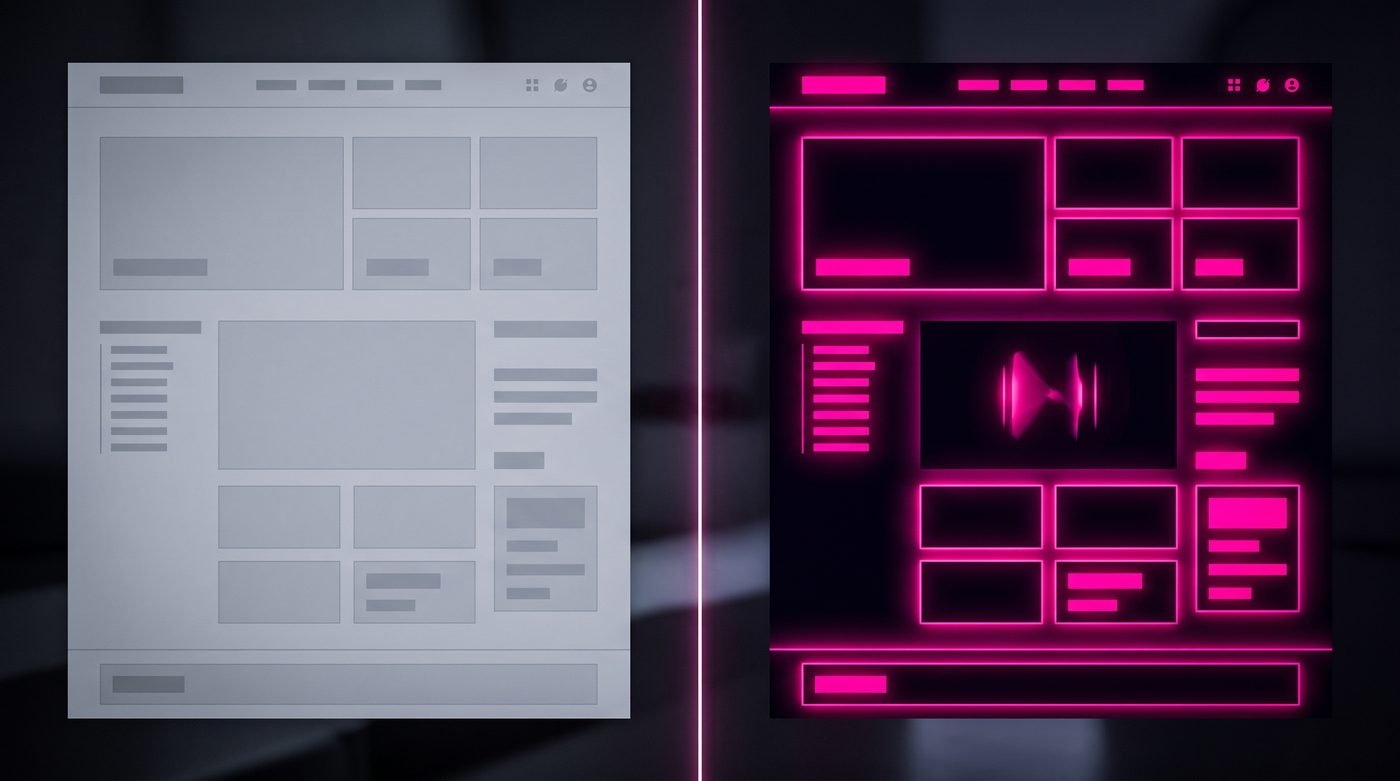
This is less about following fashion and more about standing out. If every competitor in your sector has a white website with blue accents, a well-executed dark or bold design immediately sets you apart. You're looking at one right now: this site is our own case study in point.
The key phrase is "well-executed". Bold choices require strong typography, careful contrast ratios and a clear brand identity to underpin them. Without that foundation, bold quickly becomes busy.
Trend 6: micro-interactions that guide your audience
Micro-interactions are the small animations and responses that happen when your audience interacts with your site: a button that shifts colour on hover, a form field that highlights when selected, a subtle confirmation that a message has been sent.
These details matter more than most people think. They make a website feel alive and responsive, they reduce confusion by confirming that actions have worked, and they quietly guide visitors towards the actions you want them to take.
The best small business websites use micro-interactions with restraint. One or two well-placed animations will always outperform a site that animates everything.
Trend 7: AI-assisted personalisation (done right)
AI-driven personalisation is no longer reserved for large ecommerce brands. Small business websites are starting to use it in practical, low-cost ways:
- Showing different content or calls to action depending on how a visitor arrived: paid ad, organic search or direct
- Recommending related services or products based on pages already viewed
- Chat that handles common questions instantly, without needing a member of staff available
The qualifier is "done right". Personalisation that feels intrusive or clunky does more harm than good. The goal is to make your site feel more relevant to each visitor, not to make them feel tracked. For most UK small businesses, the practical starting point is a well-configured chat widget that handles enquiries outside business hours. That alone can meaningfully increase the leads your site generates.
Trend 8: accessibility as standard, not an afterthought
Web accessibility has been a legal and ethical consideration for years. In 2026, it's also a commercial one. Accessible websites reach more people, perform better in search and carry less legal risk as UK accessibility regulations continue to tighten.
In practice, accessibility means sufficient colour contrast, alt text on all images, keyboard-navigable menus and forms, readable font sizes (16px minimum for body text) and descriptive link text rather than "click here".
None of this is difficult when accessibility is considered from the start of a build. It becomes expensive to retrofit later.
Trend or noise? Test your instincts
Not everything wearing the "2026 trend" label deserves your budget. Tap each card and see if your instinct matches ours.
How does your current site score?
Run your own website through the eight trends. Be honest, and open your site on your phone while you do it.
What these trends mean for your business
Not every trend on this list applies to every business. A trades company in Yorkshire has different priorities to a hospitality brand in Leeds. The right decisions depend on your audience, your goals and where your current site is falling short.
What these trends share is a common thread: they all serve the visitor first. Fast, clear, accessible, authentic. These qualities make websites easier to use and easier to trust, and that trust converts into enquiries, bookings and sales. We wrote more about that thinking in nine principles for a website that earns its keep.
Questions we get asked
The trends making the biggest practical difference for UK SMEs are mobile-first design, fast page load speeds, clear navigation, authentic photography and accessibility. These aren't just aesthetic choices. They directly affect how many visitors convert into customers.
A full redesign every three to four years is a reasonable benchmark, but your site should be reviewed annually. If it's slow, looks dated compared to competitors or isn't generating enquiries, those are signals to act sooner rather than later.
Some do, directly. Page speed, mobile responsiveness and accessibility all influence how Google ranks your site. Others, like bold colour choices or micro-interactions, improve the experience for your audience, which reduces bounce rates and increases time on site. Both matter for SEO.
It can be, but it depends on your brand and audience. Dark mode works well for premium, creative or tech-adjacent businesses. It requires careful execution: strong typography, correct contrast ratios and a clear brand identity. It's a deliberate choice, not a default one.
Costs vary significantly depending on complexity, functionality and who builds it. A custom-built, brand-aligned website from a full-service agency will cost more than a template build, but it will perform better and reflect your business more accurately. Our website cost calculator gives you a realistic range in about a minute.
It depends on where your current site stands. Sometimes targeted improvements, like faster hosting, better navigation or updated imagery, are enough. Other times the underlying structure is too limiting to fix without a full rebuild. A proper audit will tell you which situation you're in before you commit to any spend.
If your site failed the check, it's worth a conversation
We've helped 60+ businesses across the UK build websites that are fast, clear and unmistakably theirs. We don't start with templates or trends. We start with your business, your audience and what you actually need your website to achieve.
If your website isn't working as hard as your business is, we'll give you an honest view of what's holding it back, and whether it needs a refresh or a rebuild.